
PRESS
Welcome to the MOLUK press room.
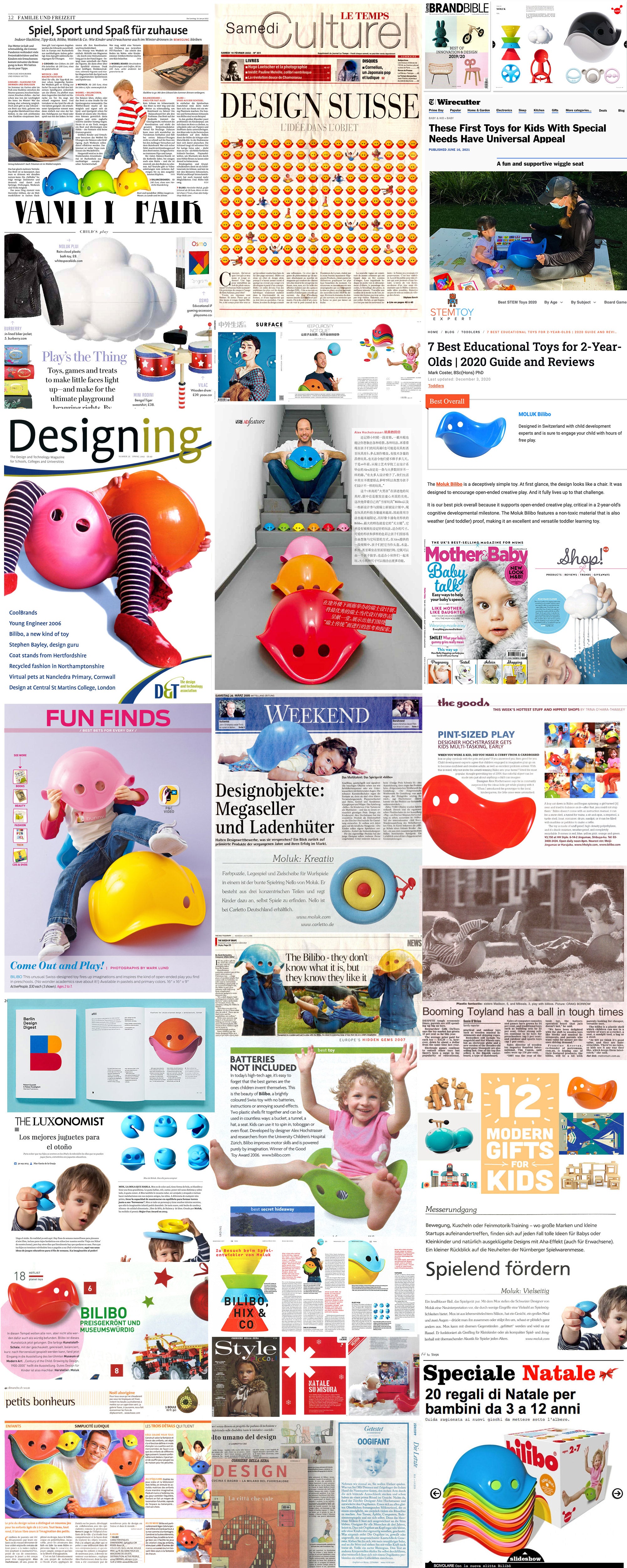
Explore a selection of articles, and international press coverage celebrating our toys and design philosophy. From museum features to parenting magazines and design blogs, MOLUK has been making waves around the world.
For media inquiries, interview requests, or collaboration opportunities, please contact us at:
press@moluk.com
MOLUK Presseinformation 25 Jahre Bilibo DE
MOLUK Press Information 25 Years Bilibo EN
MOLUK Informations Presse 25 ans Bilibo FR
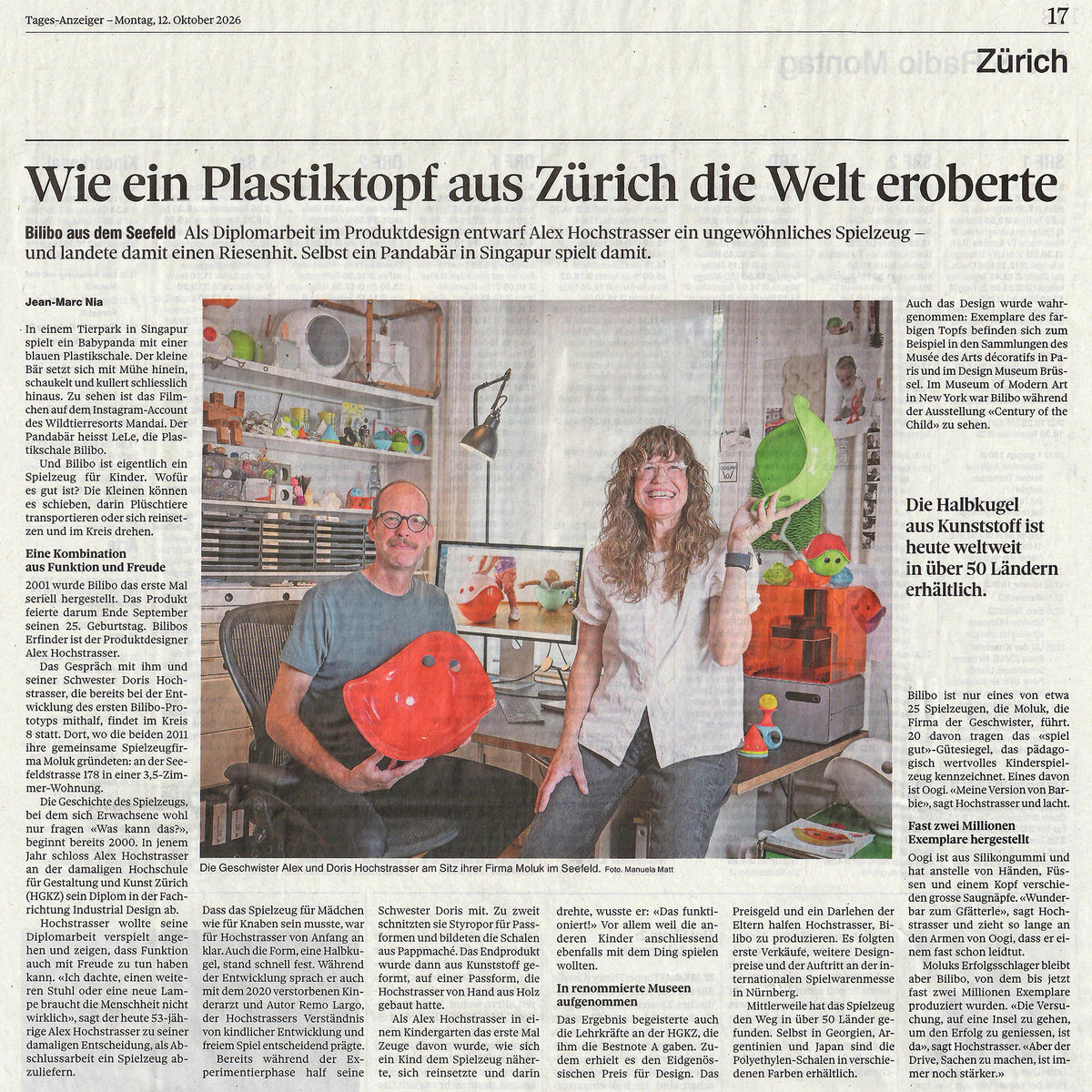
How a Plastic Shell from Zurich Conquered the World.
Swiss newspaper Tages-Anzeiger celebrates Bilibo's 25th anniversary with a portrait of MOLUK founders Alex and Doris Hochstrasser.
Jean-Marc Nia traces Bilibo's journey from a graduation project to children's playrooms in more than 50 countries and international museum exhibitions.
Nia writes: "Hochstrasser wanted to take a playful approach to his graduation project and show that function can also bring joy. 'I thought humanity didn't really need another chair or a new lamp,' says the now 53-year-old, recalling his decision to submit a toy as his final project."
Along the way, readers meet Oogi – Alex's unconventional answer to Barbie – and discover how one smiling shell grew into a whole family of open-ended toys.
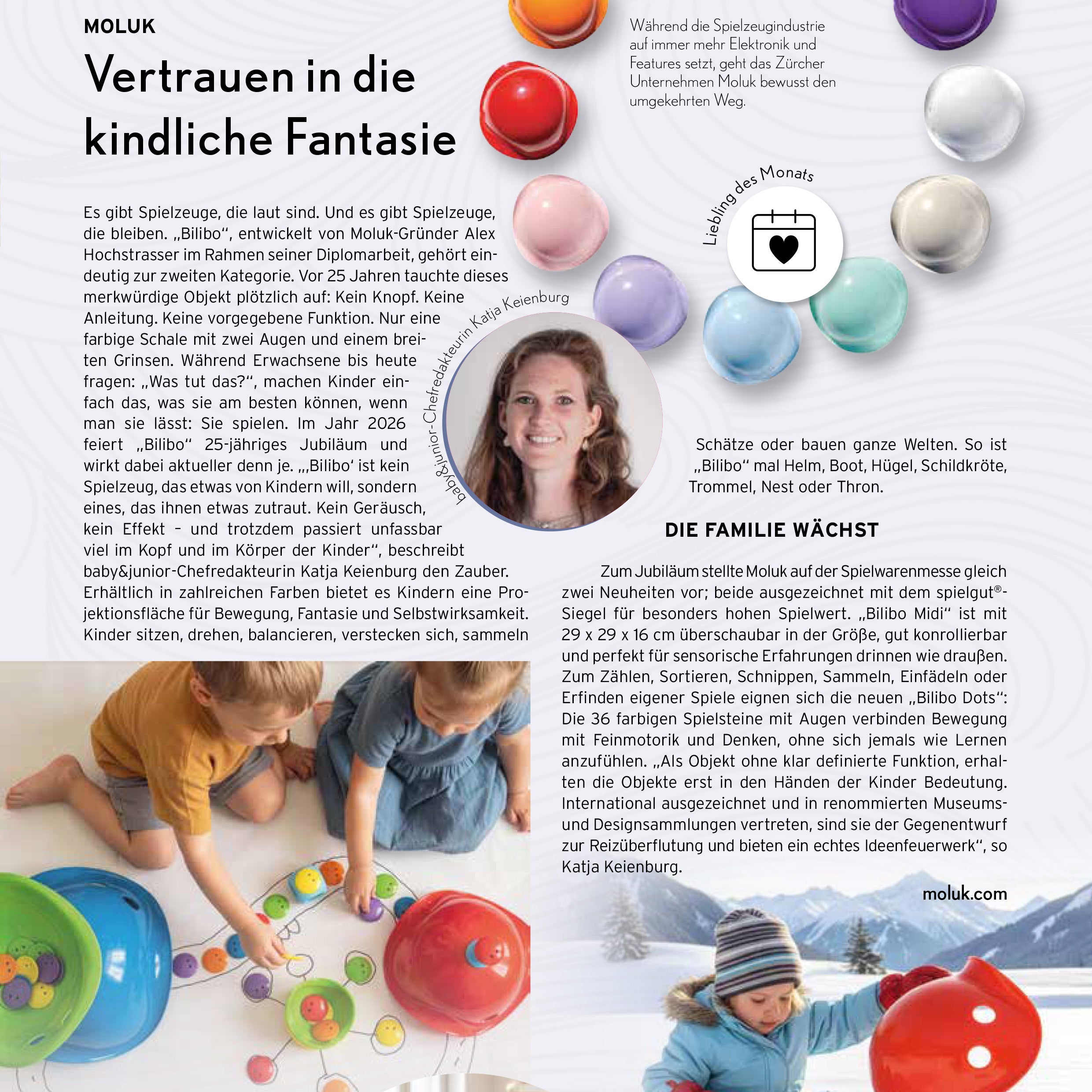
Trusting the Child's Imagination – baby&junior Magazine with a thoughtful article on Bilibo's 25th anniversary and the launch of Bilibo Midi and Dots:
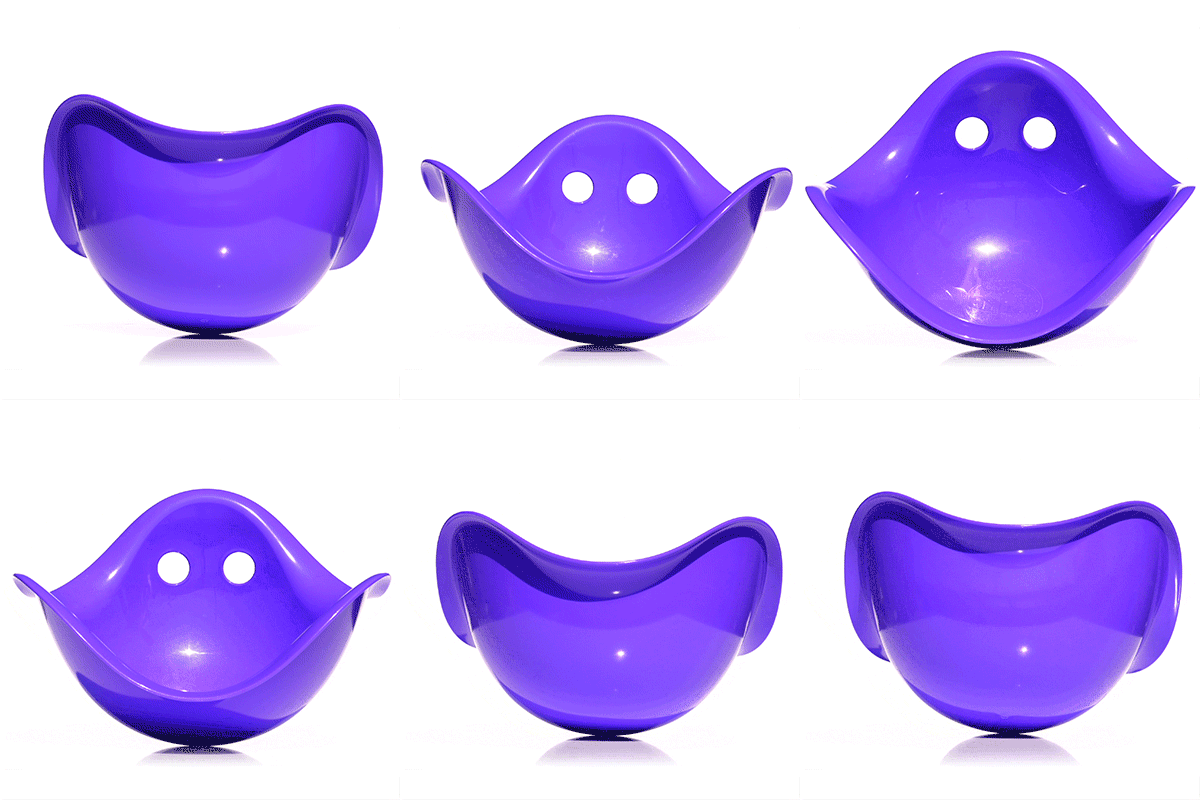
"There are toys that are loud. And there are toys that last. Bilibo, developed by MOLUK founder Alex Hochstrasser as part of his graduation thesis, clearly belongs to the latter category. Twenty-five years ago, this peculiar object appeared out of nowhere: no buttons, no instructions, no predefined function. Just a colorful shell with two eyes and a broad smile. While adults still ask "What does it do?", children simply do what they do best when left to their own devices: they play.
In 2026, Bilibo celebrates its 25th anniversary and feels more relevant than ever.
“Bilibo is not a toy that demands something from children, but one that trusts them. No sound, no effects – and yet an astonishing amount happens in children’s minds and bodies,” describes baby&junior editor-in-chief Katja Keienburg, capturing its quiet magic."
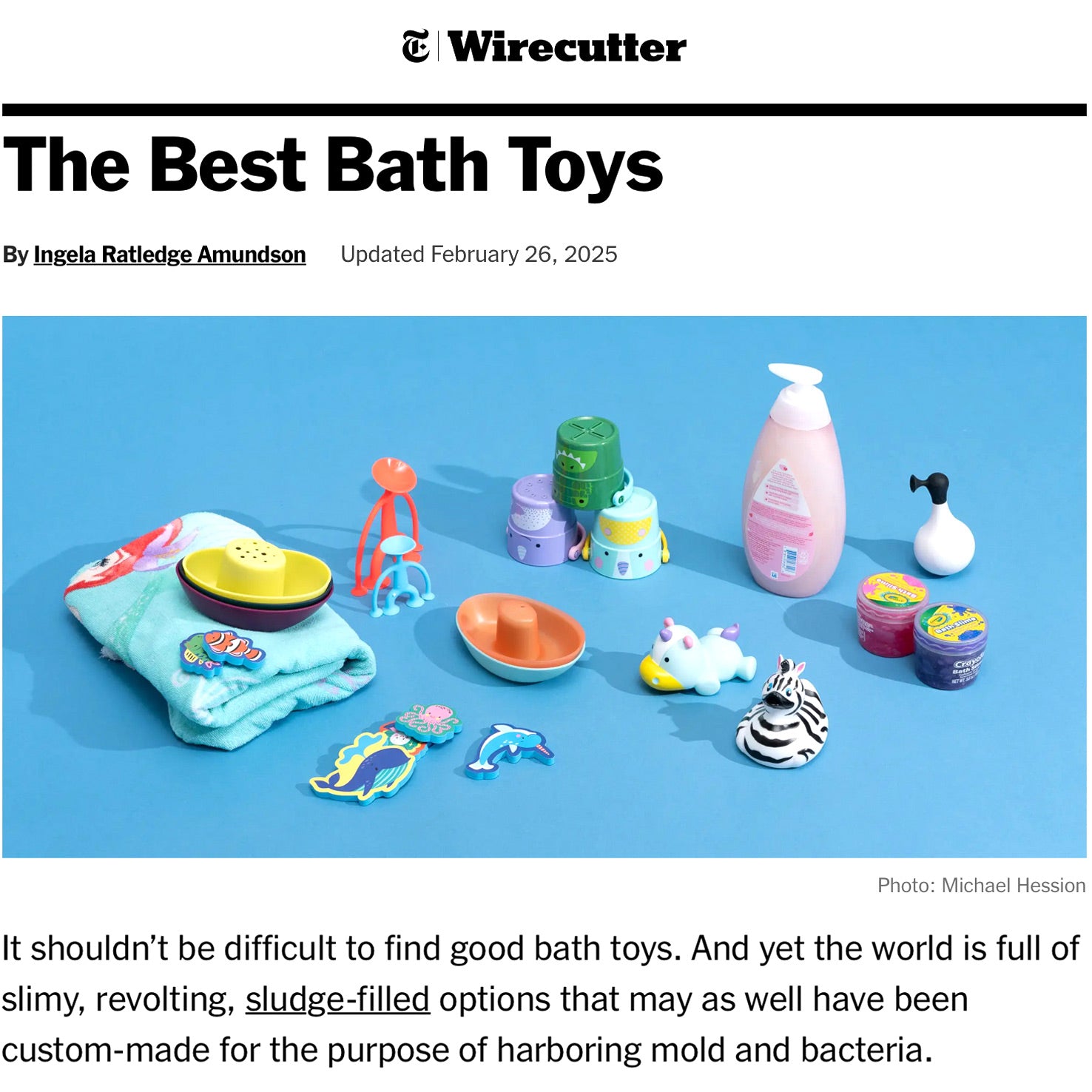
The New York Times’ Wirecutter features 4 MOLUK toys in its selection of the 15 Best Bath Toys!
Ingela Ratledge Amundson writes: “I researched hundreds of bath toys, and I spent over a year testing more than 50 of them with my family. (It turns out you’re never too old to appreciate some mid-shower entertainment.) The 15 toys we recommend are thoughtfully designed, fun to play with, and low-maintenance.”
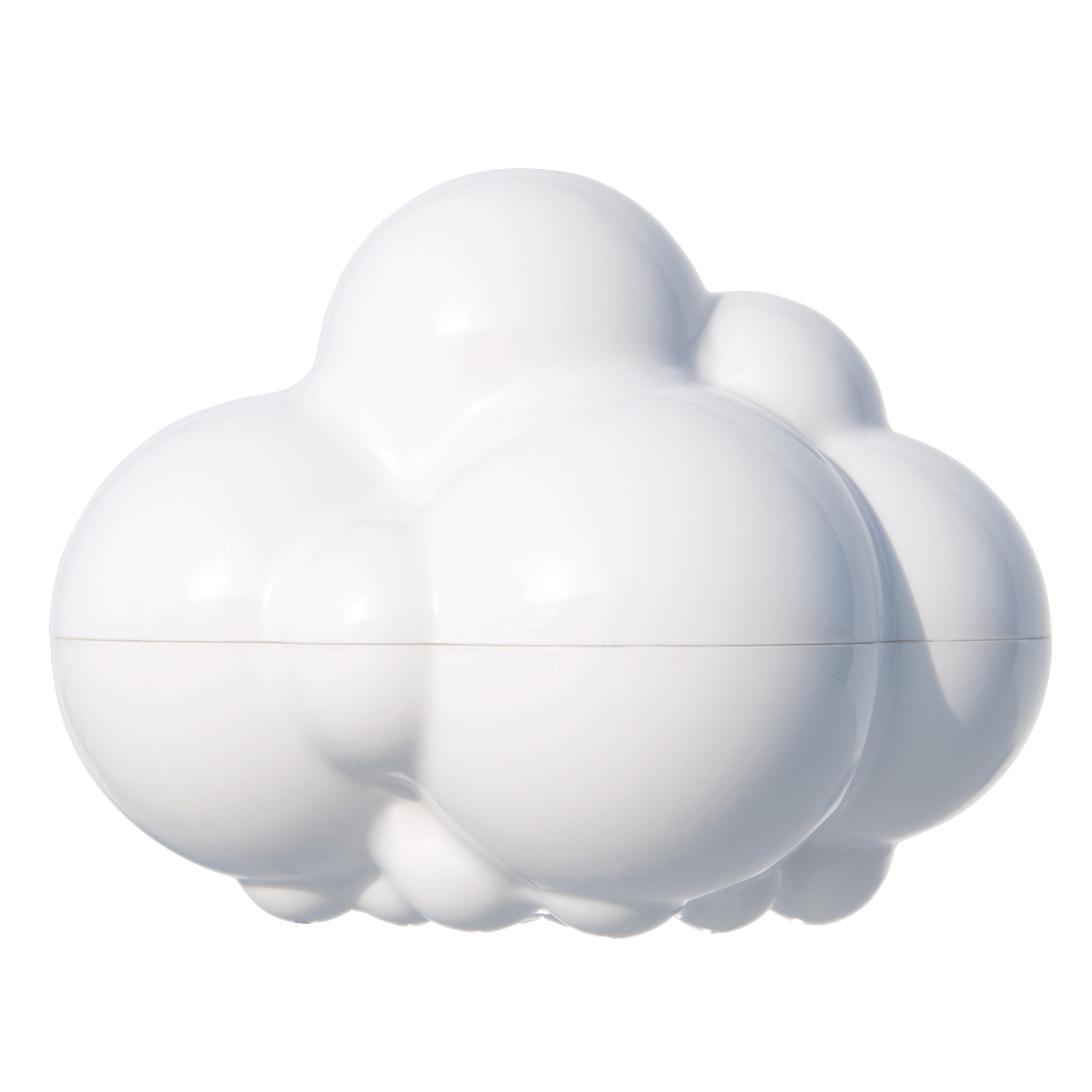
Bilibo Mini, Boi, the Oogi Family, and the Pluï Rain Cloud all made the cut!

Parents Magazine is including Bilibo in its guide to the Best Sports and Outdoor Gifts for 2-Year-Olds:
"What is this thing? Well, we can tell you that it's a durable, non-toxic, shell-shaped piece of plastic.But beyond that, it's entirely up to your kiddo to decide. This beloved toy inspires endless imagination and creativity among toddlers. Available in a variety of bright, fun colors, the Bilibo helps little ones improve their balance and coordination as they sit in it, stand in it, stack it, wear it, or stow things in it. Parents of children with special needs rave about the many benefits of this seemingly simple toy for children of all ages."
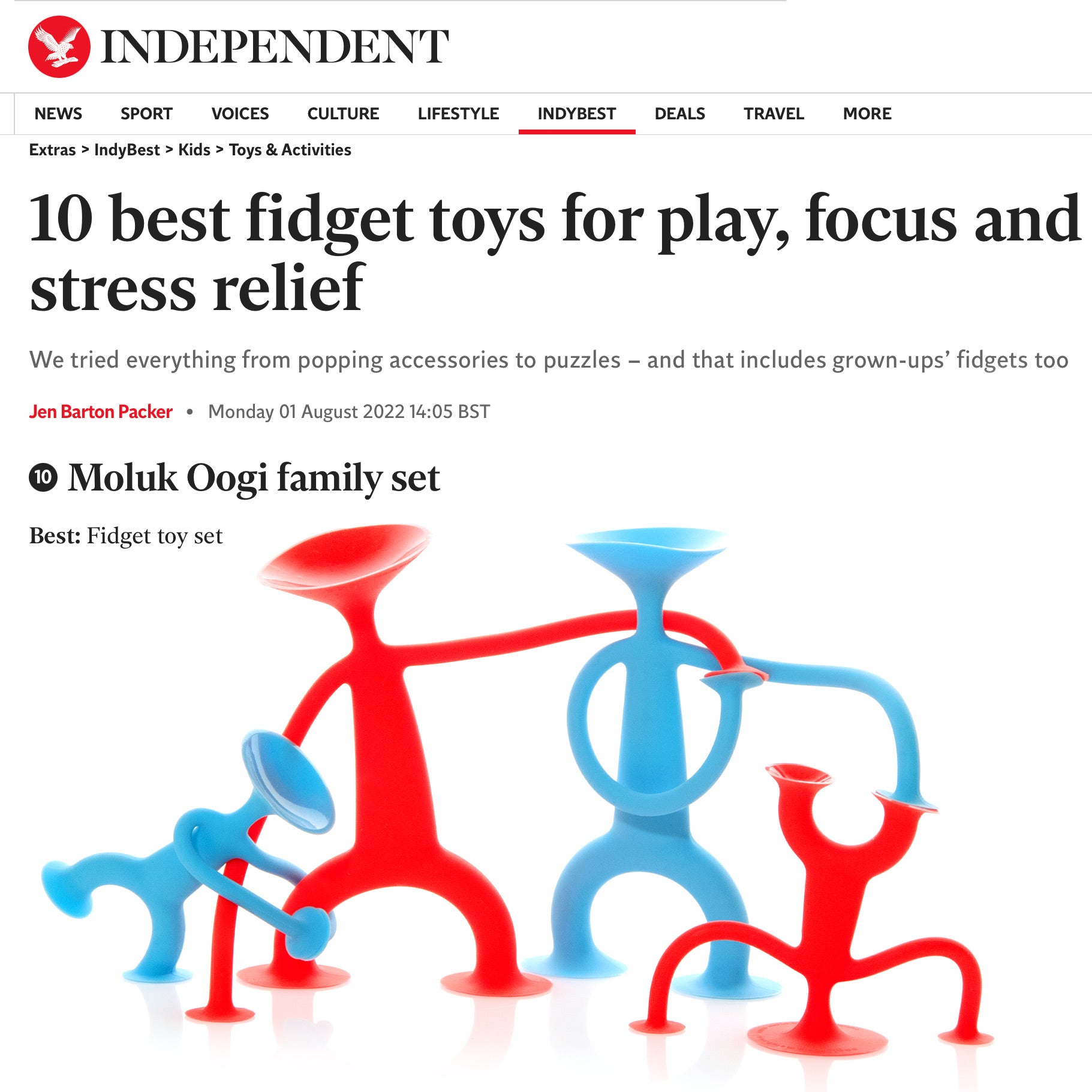
The Oogi Family is featured by the Independent in its guide to the BEST FIDGET TOYS.
Jen Barton Packer writes: "Sometimes fidget toys can be pocket-money toys that tweens collect; other times, they’re multi-taskers that even younger kids will enjoy. And Moluk really is a Swiss toy brand you should have on your radar as it makes everything from bath toys to stacking ones. The Oogi Family set includes two larger and two smaller figures, which can be stretched, suckered and stuck together in any combination or direction. These guys attach to windows, too, so don’t forget them for fidgeters on car trips."
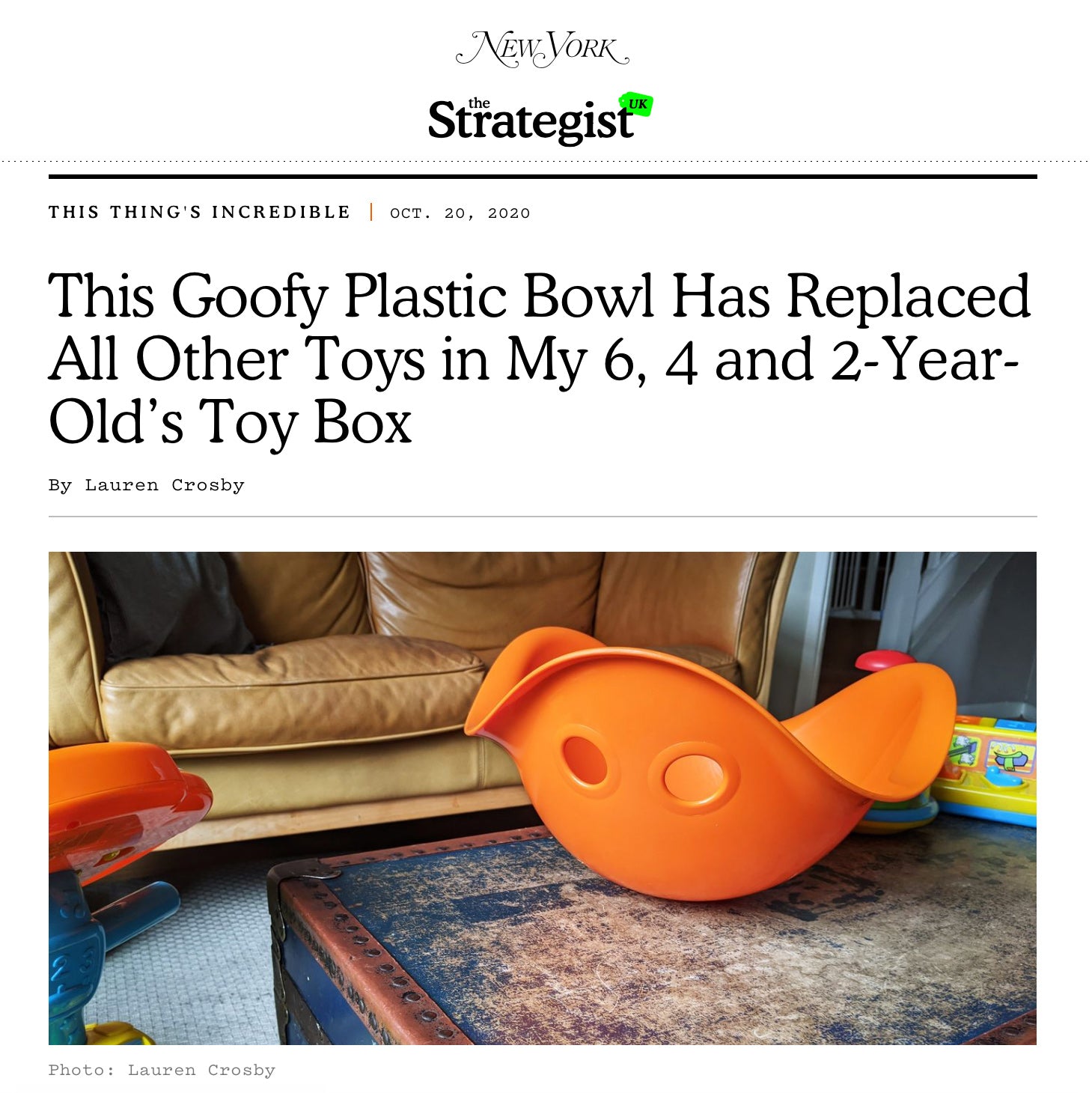
THIS THING'S INCREDIBLE - Lauren Crosby writes in her review of Bilibo for the Strategist UK:
„One by one, they took turns jumping on it, spinning, wearing, and banging it, each amused by its possibilities for play. As the Bilibo (or the ‘big, orange bowl’ as my sons call it) is made of hard plastic, there is no chance of breaking it. It can hold the weight of my 6-year-old when he turns it upside down and uses it to balance on one foot. When playing dress-up, my 4-year-old places it on his head as a fireman’s hat. If cars are out, the 2-year-old makes use of the Bilibo’s wavy edge which allows it to be used as a tunnel or bridge for cars to race under and over. … But by far, it is most used as a spinning seat — they plop their bums into the Bilibo ‘bowl’ and use pent up energy to propel them round and round. And it doesn’t have batteries — a lifesaver for the noise level in our bustling home.“
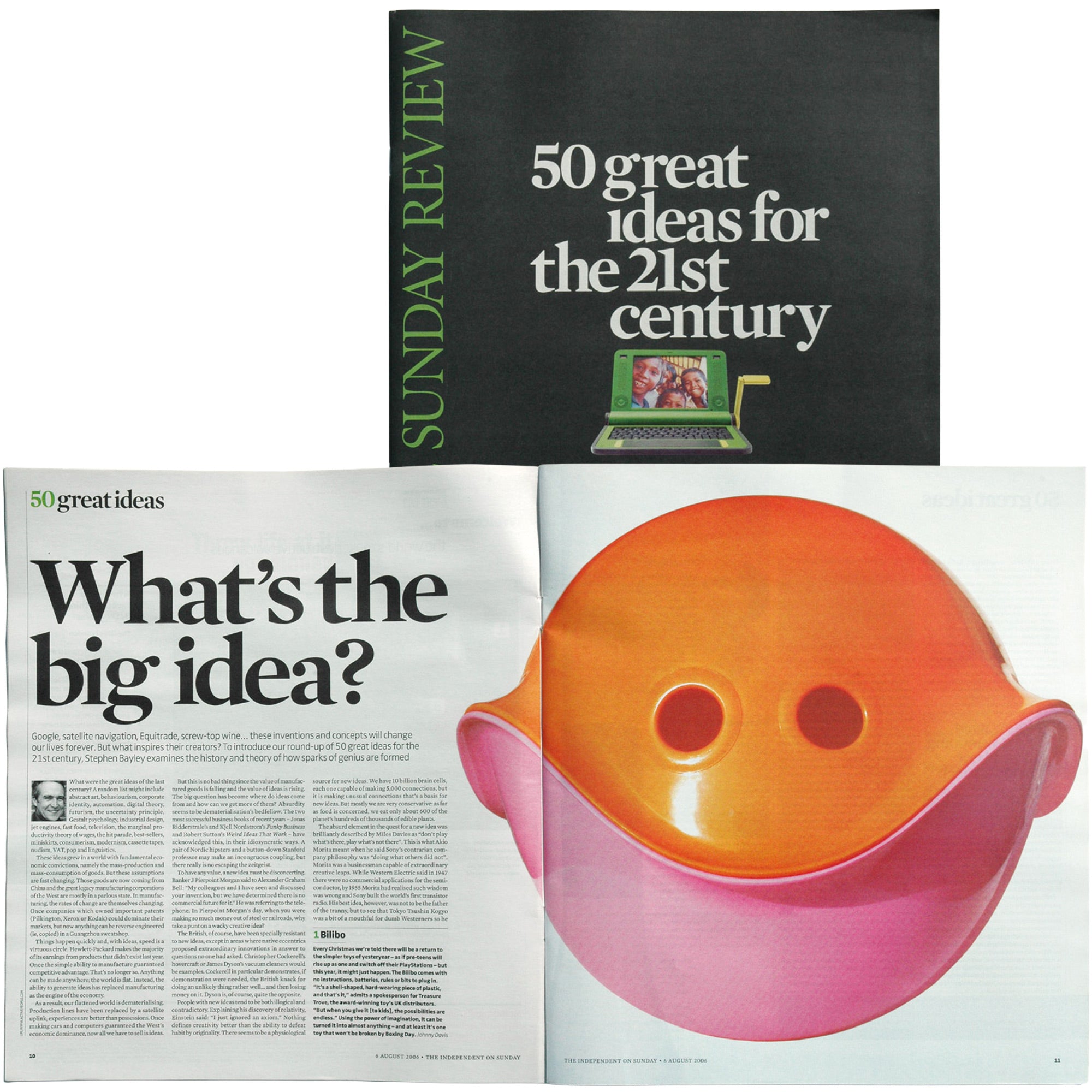
The Independent’s Sunday Review includes Bilibo as number 1 in its survey of “50 great ideas for the 21st century”.
Johnny Dovis writes: "Every Christmas we're told there will be a return to the simpler toys of yesteryear – as if pre-teens will rise up as one and switch off their PlayStations - but this year, it might just happen. The Bilibo comes with no instructions, batteries, rules, or bits to plug in. … But when you give it [to kids], the possibilities are endless. Using the power of imagination, it can be turned into almost anything – and at least it's one toy that won't be broken by Boxing Day."
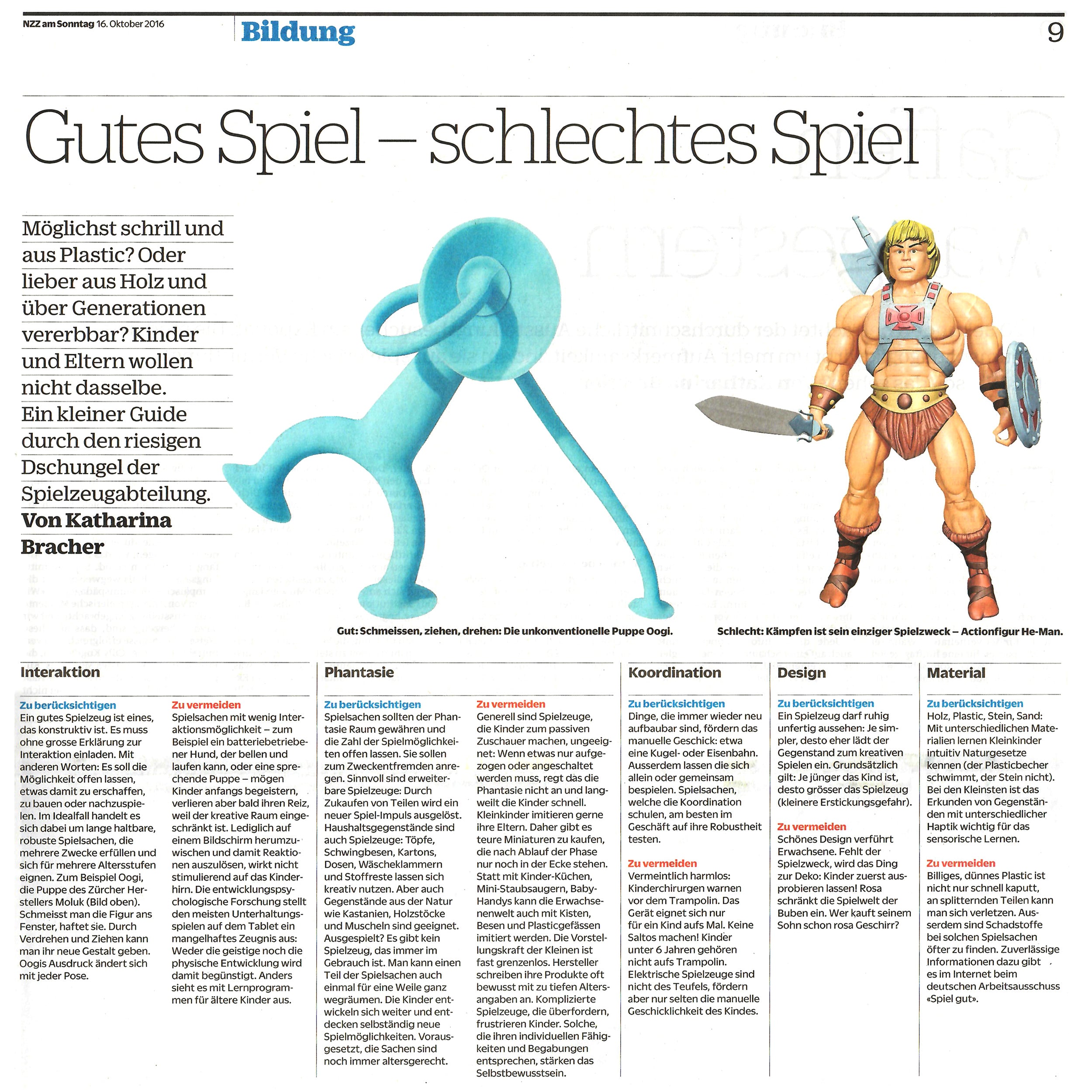
In its Sunday edition, Switzerland’s leading newspaper NZZ turned its attention to the question of what makes a good toy – and highlighted MOLUK’s Oogi as an example.
Katharina Bracher writes: "A good toy is one that is constructive. It should invite children to interact without the need for lengthy instructions. In other words, it must leave space to build, invent, or act out new scenarios. Ideally, such toys are durable, versatile, and appealing across a wide range of ages. Take Oogi, the figure created by Zurich-based manufacturer MOLUK (pictured above). Thrown against a window, it clings. Twist and tug at its elastic limbs and it morphs into new shapes. With every pose, Oogi’s expression changes."

Toy expert Stephanie Oppenheim recommends the MOLUK BUILDING GENIUS Set in the Washington Post’s Holiday Gift Guide 2020:
“This nine-piece silicone building block set inspires creativity. Its elasticity sets it apart and allows toddlers to stack and build with endless possibilities.“
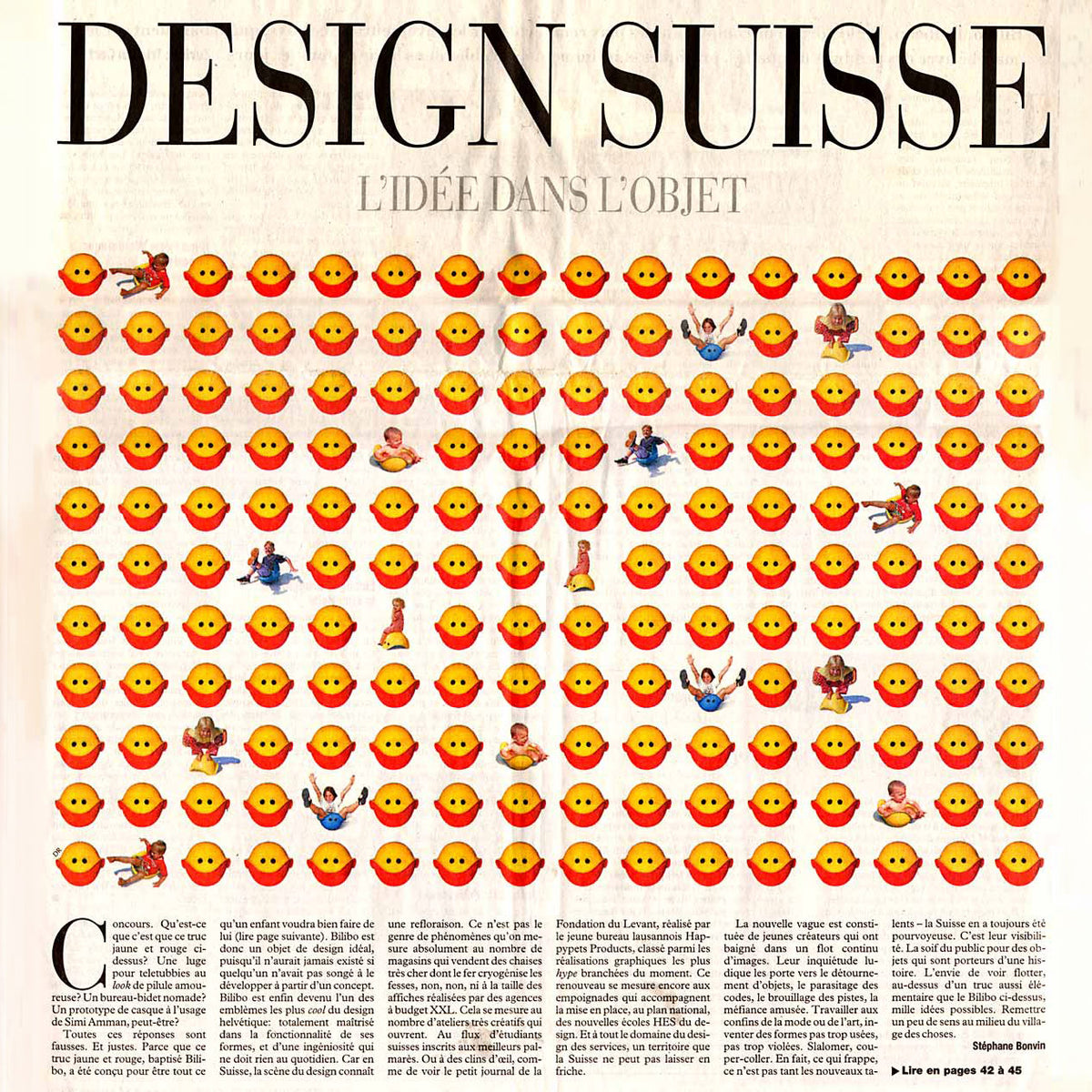
Swiss Design – The Idea Behind the Object
In February 2002, Swiss newspaper Le Temps put Bilibo on the cover of its cultural supplement devoted to Swiss design. Just months after its launch, the toy featured as an example of a new generation combining inventive ideas, simple forms and a playful approach to everyday objects.
Stéphane Bonvin writes: "Bilibo has become one of the coolest emblems of Swiss design: masterfully shaped for practical use, yet ingeniously out of the ordinary."
In the accompanying feature, Tristan Cerf writes: "Bilibo is a stroke of genius, designed and developed by Alex Hochstrasser, a designer not yet 30, already known for giving children a compelling alternative to television and video games. Bilibo has no recognizable shape or obvious function; yet it has a soul and two little holes that look like eyes and serve as a handle. […] No microchip, no intelligent processor: Bilibo is no Tamagotchi and needs neither petting nor batteries to spring to life."
How a Plastic Shell from Zurich Conquered the World.
Swiss newspaper Tages-Anzeiger celebrates Bilibo's 25th anniversary with a portrait of MOLUK founders Alex and Doris Hochstrasser.
Jean-Marc Nia traces Bilibo's journey from a graduation project to children's playrooms in more than 50 countries and international museum exhibitions.
Nia writes: "Hochstrasser wanted to take a playful approach to his graduation project and show that function can also bring joy. 'I thought humanity didn't really need another chair or a new lamp,' says the now 53-year-old, recalling his decision to submit a toy as his final project."
Along the way, readers meet Oogi – Alex's unconventional answer to Barbie – and discover how one smiling shell grew into a whole family of open-ended toys.
Trusting the Child's Imagination – baby&junior Magazine with a thoughtful article on Bilibo's 25th anniversary and the launch of Bilibo Midi and Dots:
"There are toys that are loud. And there are toys that last. Bilibo, developed by MOLUK founder Alex Hochstrasser as part of his graduation thesis, clearly belongs to the latter category. Twenty-five years ago, this peculiar object appeared out of nowhere: no buttons, no instructions, no predefined function. Just a colorful shell with two eyes and a broad smile. While adults still ask "What does it do?", children simply do what they do best when left to their own devices: they play.
In 2026, Bilibo celebrates its 25th anniversary and feels more relevant than ever.
“Bilibo is not a toy that demands something from children, but one that trusts them. No sound, no effects – and yet an astonishing amount happens in children’s minds and bodies,” describes baby&junior editor-in-chief Katja Keienburg, capturing its quiet magic."
The New York Times’ Wirecutter features 4 MOLUK toys in its selection of the 15 Best Bath Toys!
Ingela Ratledge Amundson writes: “I researched hundreds of bath toys, and I spent over a year testing more than 50 of them with my family. (It turns out you’re never too old to appreciate some mid-shower entertainment.) The 15 toys we recommend are thoughtfully designed, fun to play with, and low-maintenance.”
Bilibo Mini, Boi, the Oogi Family, and the Pluï Rain Cloud all made the cut!
Parents Magazine is including Bilibo in its guide to the Best Sports and Outdoor Gifts for 2-Year-Olds:
"What is this thing? Well, we can tell you that it's a durable, non-toxic, shell-shaped piece of plastic.But beyond that, it's entirely up to your kiddo to decide. This beloved toy inspires endless imagination and creativity among toddlers. Available in a variety of bright, fun colors, the Bilibo helps little ones improve their balance and coordination as they sit in it, stand in it, stack it, wear it, or stow things in it. Parents of children with special needs rave about the many benefits of this seemingly simple toy for children of all ages."
The Oogi Family is featured by the Independent in its guide to the BEST FIDGET TOYS.
Jen Barton Packer writes: "Sometimes fidget toys can be pocket-money toys that tweens collect; other times, they’re multi-taskers that even younger kids will enjoy. And Moluk really is a Swiss toy brand you should have on your radar as it makes everything from bath toys to stacking ones. The Oogi Family set includes two larger and two smaller figures, which can be stretched, suckered and stuck together in any combination or direction. These guys attach to windows, too, so don’t forget them for fidgeters on car trips."
THIS THING'S INCREDIBLE - Lauren Crosby writes in her review of Bilibo for the Strategist UK:
„One by one, they took turns jumping on it, spinning, wearing, and banging it, each amused by its possibilities for play. As the Bilibo (or the ‘big, orange bowl’ as my sons call it) is made of hard plastic, there is no chance of breaking it. It can hold the weight of my 6-year-old when he turns it upside down and uses it to balance on one foot. When playing dress-up, my 4-year-old places it on his head as a fireman’s hat. If cars are out, the 2-year-old makes use of the Bilibo’s wavy edge which allows it to be used as a tunnel or bridge for cars to race under and over. … But by far, it is most used as a spinning seat — they plop their bums into the Bilibo ‘bowl’ and use pent up energy to propel them round and round. And it doesn’t have batteries — a lifesaver for the noise level in our bustling home.“
The Independent’s Sunday Review includes Bilibo as number 1 in its survey of “50 great ideas for the 21st century”.
Johnny Dovis writes: "Every Christmas we're told there will be a return to the simpler toys of yesteryear – as if pre-teens will rise up as one and switch off their PlayStations - but this year, it might just happen. The Bilibo comes with no instructions, batteries, rules, or bits to plug in. … But when you give it [to kids], the possibilities are endless. Using the power of imagination, it can be turned into almost anything – and at least it's one toy that won't be broken by Boxing Day."
In its Sunday edition, Switzerland’s leading newspaper NZZ turned its attention to the question of what makes a good toy – and highlighted MOLUK’s Oogi as an example.
Katharina Bracher writes: "A good toy is one that is constructive. It should invite children to interact without the need for lengthy instructions. In other words, it must leave space to build, invent, or act out new scenarios. Ideally, such toys are durable, versatile, and appealing across a wide range of ages. Take Oogi, the figure created by Zurich-based manufacturer MOLUK (pictured above). Thrown against a window, it clings. Twist and tug at its elastic limbs and it morphs into new shapes. With every pose, Oogi’s expression changes."
Toy expert Stephanie Oppenheim recommends the MOLUK BUILDING GENIUS Set in the Washington Post’s Holiday Gift Guide 2020:
“This nine-piece silicone building block set inspires creativity. Its elasticity sets it apart and allows toddlers to stack and build with endless possibilities.“
Swiss Design – The Idea Behind the Object
In February 2002, Swiss newspaper Le Temps put Bilibo on the cover of its cultural supplement devoted to Swiss design. Just months after its launch, the toy featured as an example of a new generation combining inventive ideas, simple forms and a playful approach to everyday objects.
Stéphane Bonvin writes: "Bilibo has become one of the coolest emblems of Swiss design: masterfully shaped for practical use, yet ingeniously out of the ordinary."
In the accompanying feature, Tristan Cerf writes: "Bilibo is a stroke of genius, designed and developed by Alex Hochstrasser, a designer not yet 30, already known for giving children a compelling alternative to television and video games. Bilibo has no recognizable shape or obvious function; yet it has a soul and two little holes that look like eyes and serve as a handle. […] No microchip, no intelligent processor: Bilibo is no Tamagotchi and needs neither petting nor batteries to spring to life."